

Ferry Flights - Rockwell Aero Commander 1000
Hi everyone,
I’ve had a few friends and colleagues asking me about unusual aircraft I’ve flown. Well, here is one which I have been looking after for over a year now in Johannesburg, South Africa, and which I will soon be ferrying up to the Isle of Man in the UK.
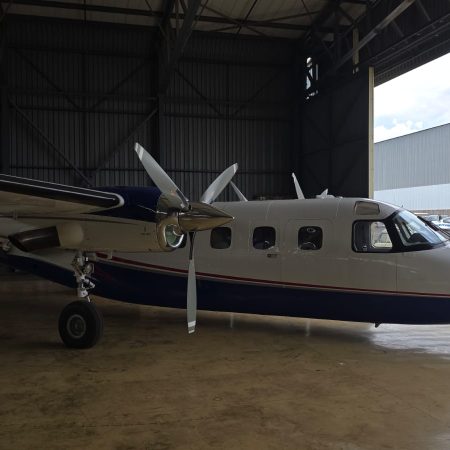
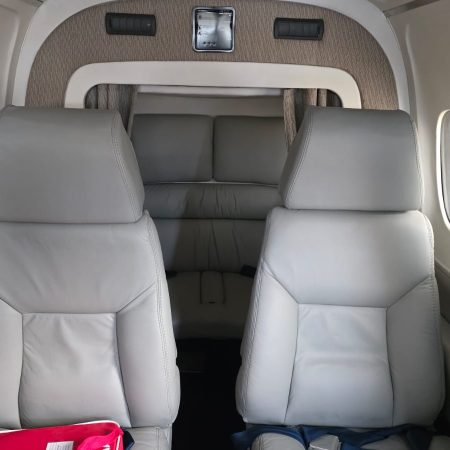
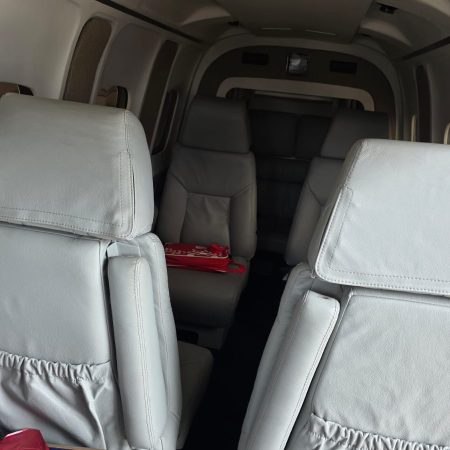
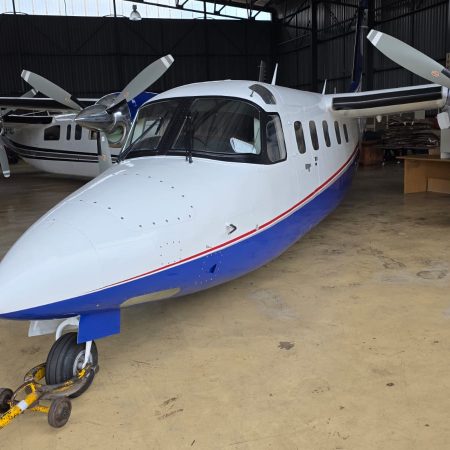
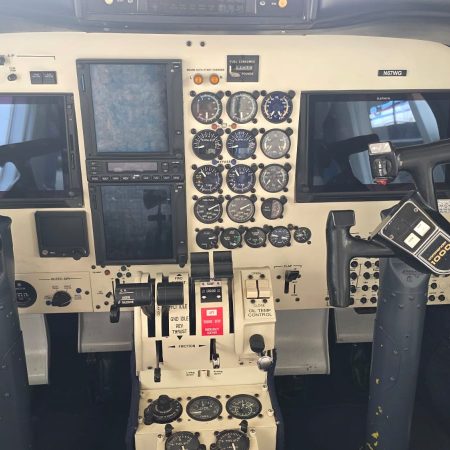
It is a 1982 model Rockwell Aero Commander 1000 – also known as a 690 A/B. This particular aircraft has been upgraded with a new glass cockpit, including Garmin 690/750 units and various other goodies.
It was also completely gutted and refitted, with just about everything new—from the environmental system to the pressurization, hydraulics, and electrics, all completely overhauled. It has newly factory-overhauled Dash-10 Garrett engines, brand new four-bladed props with Q-tips, and quite a lot more.
This aircraft is probably, together with the old Cessna Conquest II (also with Dash-10 Garrett engines), one of the best long-distance and fastest aircraft in this type and category ever built. There is nothing you can buy new these days that will do the same.
In the Southern Hemisphere you will reach flight level 280 very quickly (which is unfortunately the maximum without an RVSM certificate). Even so, both aircraft can easily reach FL320 and higher, depending on the weight you are carrying. You can expect a good true airspeed of around 290 knots and a range of easily 2,000 nautical miles.
In the Northern Hemisphere you will get a good 300–310 knots with about 2,100 nautical miles plus standard reserves, depending on your load. This is mainly due to the upper air temperatures usually being much cooler in the Northern Hemisphere.
Understand Garrett engines ...
The aircraft itself is not the easiest to operate, which means you really need to understand Garrett engines and how to handle them. They are fixed-shaft turbines, which require a good understanding during startup, shutdown, and high-altitude engine management. Things like getting the engines and propellers out of lock and putting them back into lock after startup and shutdown, racing out of the cockpit quickly to spin the propellers by hand to cool them down further, etc.
One of the peculiarities of this aircraft is its hydraulic steering system. It’s a bit of a nightmare to get used to—doable, but potentially very dangerous on icy or wet runways. I’ve heard of some coming off the runway and being written off.
It’s all in the rudder pedals
there are no cables to the nosewheel, just hydraulics. When you are braking, it’s still on the tips of the rudder pedals, but no steering is possible through the rudder pedals as such. You have to hydraulically steer the plane with the tips of the rudder pedals without activating the brakes. Arghhh… it’s a nightmare!
Ground steering with just the rudder will only be achieved at or above 40 knots ground speed.
Otherwise, it’s a fantastic plane to fly.
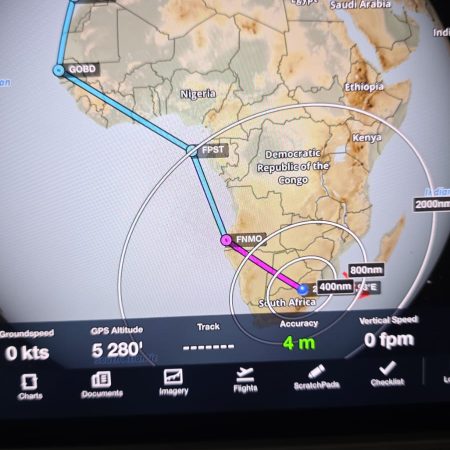
The route I will be taking is from Johannesburg to the São Tomé and Príncipe islands on the equator, off the west coast of Africa abeam of Gabon, with a fuel stop in Namibe (Welwitschia Airport) in Angola along the southern coastline—fuel is very cheap there! (Not to be confused with the country of Namibia.)
On a direct routing to São Tomé it is exactly 2,000 nautical miles, but with possible CBs along the way it is safer to fuel up in Namibe. A night stop there is quite pleasant, and the formalities are straightforward.
From there I am planning to fly direct to Dakar in Senegal for a night stop. The owner of the aircraft will be coming along, so there will be a bit of sightseeing there and elsewhere. Then it’s on to the Canary Islands, to Tenerife North Airport, also for a night stop or two. After that, on to Porto in Portugal, and finally to the Isle of Man.